The Backyard Revolution: The 2026 Guide to Intergenerational Living & Granny Flats
Why a Secondary Dwelling is the Northern Beaches’ Smartest Play.
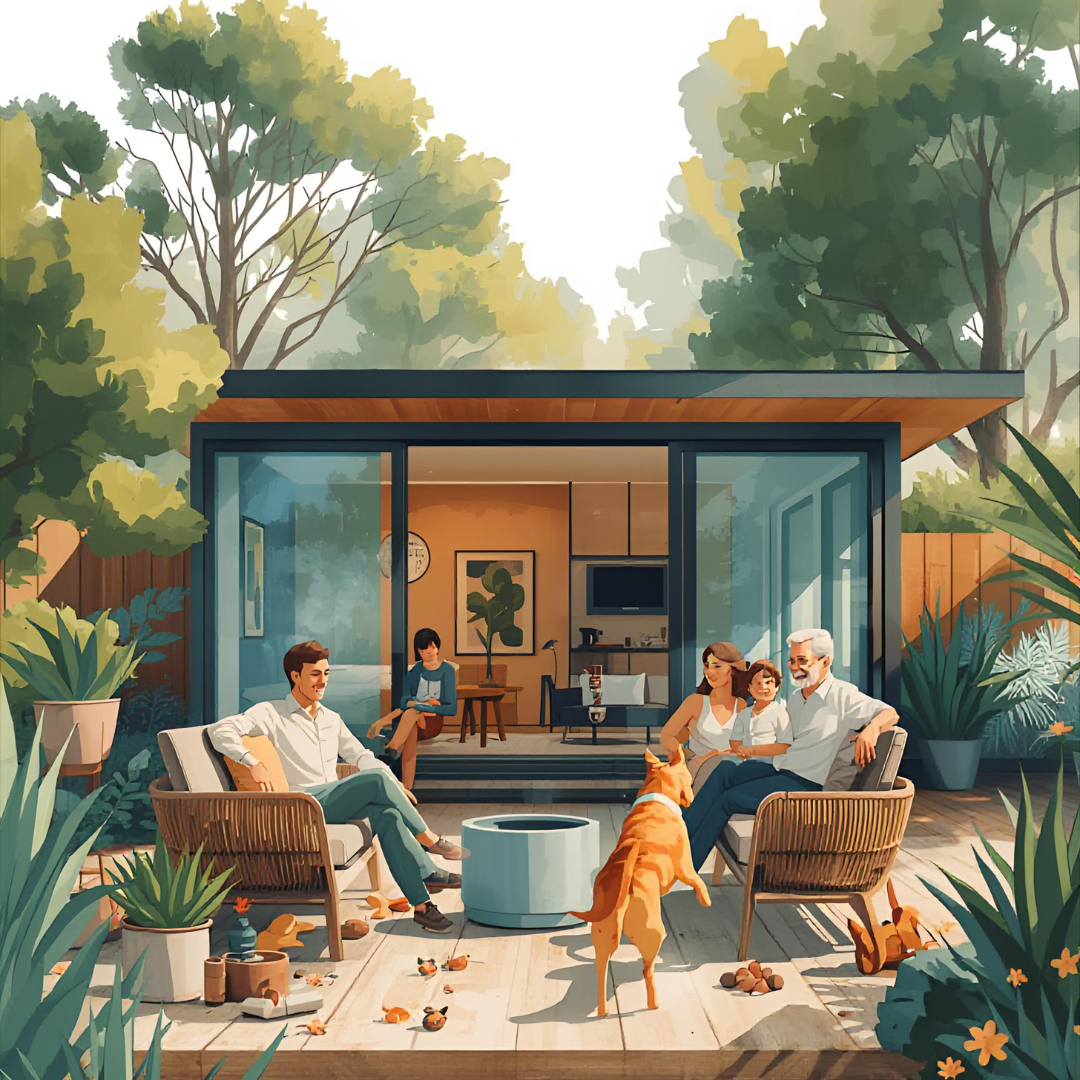
"Beyond the benefits of multi-generational housing, a granny flat represents a strategic investment that adds significant property value and rental potential."
Living on the Northern Beaches is about more than just a postcode; it’s a lifestyle. As we move through 2026, many of us are realising that future-proofing our lives doesn't have to mean moving house—it's about unlocking the potential already sitting in our backyards.
As a local builder specialising in sustainable, high-end homes, I’ve seen a massive shift in how families view their land. It’s no longer just about the "big house" at the front. Whether you’re looking to keep family close or create a recession-proof income stream, the modern "Granny Flat" has evolved into a premium architectural asset.
The Power of the Numbers
Building a secondary dwelling isn't just a renovation; it’s wealth manufacturing. Here’s why it’s the smartest equity play on the Beaches right now:
1. Instant Equity
A high-quality dwelling can increase your total property value by approximately 30%, often outweighing construction costs from day one. But remember, this is not your average granny flat. Forget the "fibreglass boxes" of the past; we’re talking architectural statements with eco-friendly designs, sustainable materials, and high-end finishes like polished concrete and custom joinery that mirror the quality of a luxury main residence.
2. Recession-Proof Rental Yield
With local vacancy rates hovering at a tight 1.6%, a modern dwelling offers a reliable, passive income stream—essentially a safety net and wealth accelerator rolled into one. A well-designed studio type or granny flat can boost your rental income potential by roughly 27%.
3. The "Sandwich Generation" & Lifestyle Preservation
The dinner table conversation is changing. We’re seeing more families staying together longer.
For the kids: It’s a way to save for a deposit while living independently.
For the parents: It’s the perfect downsizing option, letting you stay in the postcode you love while freeing up the main house for the next generation.
It’s not just about proximity; it’s about preserving your lifestyle.
The Reality Check: Navigating the Challenges
Building on the Beaches isn't always a "walk in the park." Our local landscape throws specific curveballs that can derail a project if you aren’t prepared. Here are the top three challenges we navigate for our clients:
Infrastructure & Service Upgrades: Most people budget for the "box" (the structure) but forget about the "veins" (the services). On the Northern Beaches, getting power and plumbing to the back of the block is often the most complex part of the build.
As Justin Cook, CBI Construction Director, explained, “In 20 years of building on the Beaches, I’ve only had to install a macerator pump once. The real 'hidden' work is behind the scenes: the deep excavation for services and the essential Level 2 electrical upgrades required to make a dual-occupancy property truly compliant and future-proof.”
To put it simply:
The Service Trench: Excavating and running new services to a secondary dwelling can be a major undertaking, especially with our local terrain. While some suggest mechanical pumps for plumbing, we always aim for a gravity solution first—even if it means trenching through a neighbouring property to find the right fall.
Level 2 Electrical Works: Modern granny flats have high power demands. It’s not just about a new fuse; we often need to perform Level 2 electrical works to upgrade the service supply from the street and overhaul the main switchboard to ensure the entire property is safe and compliant.:
He ended this explanation with what really matters: why he would rather do the above. It is because, “My philosophy is to find a permanent, gravity-led plumbing solution whenever possible—even if it's the harder path—because it’s the better long-term result for the client.”
Also, other things to consider are:
Topography & "The Rock": We live in a beautiful but challenging region. A standard "flat pack" won't work on a 15-degree incline. You’ll need custom engineering, like bearer and joist (stilt) construction, and potentially expensive sandstone excavation for foundations.
The Compliance Maze: Under the SEPP (State Environmental Planning Policy), you are strictly limited to 60sqm of internal space. To make this feel like a luxury home, we use clever design—high ceilings and integrated decks—to "cheat" the visual footprint while meeting rigid privacy and setback rules.
CBI Pro Tip: Most of these hurdles are cleared in the Design & Feasibility phase. By identifying sewer locations and slopes on day one, we ensure your renovation or build’s investment is worth it.
The CBI Way: Your Pre-Construction Roadmap
Because every block from Freshwater to Frenchs Forest has unique zoning and council overlays, a generic template won't work. We provide a custom Site Feasibility Assessment to bridge the gap between "legal theory" and "construction reality."
How it works:
Desktop Review: We check for "red flags" via satellite and council maps (easements, bushfire zones, etc.).
Site Visit: CBI’s Director, Justin Cook, personally comes out to check the lay of the land, machinery access, and privacy angles, often bringing our structural engineer or master plumber along.
The Report: We provide a clear overview: Can you build it? What will it look like? And what is the preliminary budget?
Why choose CBI? We don't just build; we partner with you. We use architectural stilt systems to minimise excavation on steep blocks and utilise Complying Development Certificates (CDC) to bypass lengthy Council DA processes—often cutting approval times down to just 2–4 weeks. With our 287-point quality control checklist, we ensure a stress-free process with no nasty surprises.
“I’m Ready!”
Let’s turn that dream into a reality. If you’re ready to see what’s possible on your block, we’d love to chat. We’ll walk you through the feasibility, design options, and potential returns.
Fill out our New Client Form. Once received, our Operations Manager will get in touch within 24 hours to book your initial on-site meeting with our Director, Justin Cook.
“Quality at the Core. Built for the Northern Beaches.”
FAQS
Here are the Top 10 Questions we are fielding right now from clients in Freshwater, Allambie, Mona Vale, and surrounds.
1. "My block is steep. Does that kill the project?"
The Honest Answer: It doesn't kill it, but it changes the budget.
Most "off-the-shelf" granny flat companies quote for flat slabs. On the Beaches, flat land is rare. If you have a slope, we likely need to use a bearer and joist system (stilt construction) rather than a concrete slab.
Pros: Less excavation, better for tree roots, and often looks more architectural.
Cons: It costs more than a slab. We usually need to factor in an extra $10k–$20k for piers and engineering depending on the grade.
2. "Can I avoid Northern Beaches Council and just use a Private Certifier?"
The Honest Answer: almost always YES, and you should.
If your design meets the State Environmental Planning Policy (SEPP) guidelines, we can bypass the slow Council DA process and use a CDC (Complying Development Certificate).
Time difference: Council DA = 3–6 months. Private Certifier CDC = 2–4 weeks.
Caveat: If you want to build closer to the boundary than the standard rules allow, or if you have a Heritage overlay, we must go to Council.
3. "How big can I actually build?"
The Honest Answer: The golden number is 60sqm for the internal living space.
However, this does not include patios, verandas, or carports.
CBI Pro Tip: We often design a 60sqm internal footprint with a massive, integrated 20sqm covered deck. With bi-fold doors, your "usable" living space feels like 80sqm+ without breaking the law.
4. "I have a massive Gum Tree in the backyard. Can I remove it?"
The Honest Answer: Probably not, and don’t try to.
The Northern Beaches Council uses satellite monitoring and has strict canopy targets.
The Workaround: Instead of fighting the council (which you will lose), we design around the tree. We can use screw-pile foundations that don't damage roots, allowing us to build closer to the tree than a traditional slab would allow. Plus, the leafy outlook increases the rental value.
Ever wondered how to build around nature rather than against it? Take a look at our blog “CBI Project Spotlight feat. Clareville Treehouse”. It’s a great example of how we helped a client integrate a massive local tree right into their granny flat design.
5. "Will my neighbours object/stop me?"
The Honest Answer: Under a CDC (Complying Development), your neighbours cannot stop you if you meet the rules.
They are notified as a courtesy, but they cannot lodge an "objection" to block it like they can with a DA. As long as we hit the setback and privacy requirements (usually 3m from the rear fence and 0.9m from the side), you are green-lit.
6. "What is the 'hidden' cost everyone talks about?"
The Honest Answer: It’s usually Service Connections.
Your existing house has power and water, but getting those specifically to the bottom of a 900sqm block can be tricky.
Sewer: If your sewer main is uphill from the granny flat, you will need a pump system (approx. $5k–$10k).
Electrical: If your main switchboard is old, it might need an upgrade to handle the extra load of a second dwelling.
7. "Is it better to build a 1-bedroom or a 2-bedroom?"
The Honest Answer: For ROI on the Beaches? 2-Bedroom.
A 1-bedder limits you to singles or couples. A 2-bedder opens up the market to single parents, two friends sharing, or a couple needing a home office. The rental difference can be $150–$200 extra per week. If you can fit two bedrooms, do it.
8. "I’m in a Bushfire Zone (BAL). Is that a problem?"
The Honest Answer: It’s standard for us.
Most of the Beaches is bushfire prone. It just means we have to use specific materials (BAL-rated timber, gutter guards, toughened glass). It might add roughly 5-10% to the build cost, but it ensures your investment doesn't burn down.
Learn More about this here: Understanding BAL-FZ Requirements for Your Home
9. "How long until I can move someone in?"
The Honest Answer: From the moment you sign the contract:
Approvals: approximately 4 weeks.
Construction: approximately 12–16 weeks (weather permitting). Let’s say, if we start paperwork today, you could have tenants in by mid-year if you decide to have it rented or you can move in if you decide to live in it.
10. "Does this affect my Capital Gains Tax (CGT) if I sell?"
The Honest Answer: Potentially, yes.
Disclaimer: We aren't accountants. But generally, if you rent out the flat, that portion of your land may be subject to CGT when you sell the main home.
However, most clients find the rental income over 5-10 years far outweighs the potential tax hit later. (Always check with your accountant first!)
Key Reference Links
Domain: Rent Report 2025/2026
How the ‘sandwich generation’ is changing the way we live
National Vacancy Rate Falls to 1.2% | SQM Research=
Immediate' solution that could ease the housing crisis
Scan QR Code for “Granny flats Where are the greatest opportunities for development?” to check the report.